Cold War
Los pacientes del doctor GarcíaThe Cold War is the postwar struggle that transforms the novel’s political landscape and the prospects of those implicated in Nazi crimes. As fear of the Soviet Union overtakes the immediate demands of accountability, former Nazis become useful to Western governments and welcome in Francoist Spain and Perón’s Argentina. The change does not erase the evidence of their past; it changes which evidence governments are willing to act upon, and which fugitives can turn official protection into a new identity and a future.
From wartime defeat to a new political order
The end of the Third Reich does not bring a stable consensus about what should follow. In the account of Sal Burnstein’s postwar turn, the destruction of his family in Nazi camps first leaves him in profound grief, guilt, and physical collapse. Recovery does not return him to his former religious life: he does not resume attendance at the synagogue, Yiddish, or Sabbath observance. Instead, he resolves to honor, remember, and avenge his mother, siblings, and nephews. His private loss unfolds as Allied priorities are changing around him.
While the Nuremberg trials occupy newspaper front pages, some American officers complain privately that their superiors are receptive to former Nazis who argue that the West has chosen the wrong enemy. Many Allied commanders in Germany come to regard the Soviet Union as the principal danger to peace and Western civilization. As a consequence, former SS officers disappear from prisoner lists after being recruited by British and American services to work against Soviet interests in Germany. The novel presents this not as a sudden rehabilitation of the defeated regime, but as a change in the strategic value assigned to its people: men still implicated in Nazi rule can recast themselves as instruments in the next confrontation.
The Cold War also alters the diplomatic setting for Franco’s Spain. By late 1947, the anti-Soviet climate and fear of another conflict with Stalin have changed the international position created by Hitler’s defeat, to Franco’s considerable advantage. Spanish diplomacy can meet Allied demands with delay, disputed credentials, and appeals to the changed political moment. The result is a widening distance between the Allies’ stated pursuit of suspects and the practical willingness to force Spain to surrender them.
Spain’s protection of fugitives
The treatment of named fugitives makes that shift concrete. Franco hands Pierre Laval over on 30 July 1945 after French pressure and concern about offending the victors. Laval is later convicted of treason and executed in October. Yet the novel describes this cooperation with Allied justice as beginning and ending with that single transfer. Belgium continues to seek Léon Degrelle, but Franco refuses to surrender him and, in 1954, gives him lasting protection. Degrelle receives the official Spanish identity José León Ramírez Reina and uses it to establish a construction company, winning substantial public contracts. The state’s conferral of nationality turns refuge into an economic opportunity as well as a shield from extradition.
The same method can protect others: Spanish citizenship is granted retroactively, and authentic documents are prepared for fictitious identities. The novel describes this as a procedure used for decades, both for fugitives settling in Spain and for those using it as a stage on the way to another country. A false identity is therefore not simply a private deception. When state institutions authenticate it, paperwork becomes a mechanism for converting political protection into ordinary official existence.
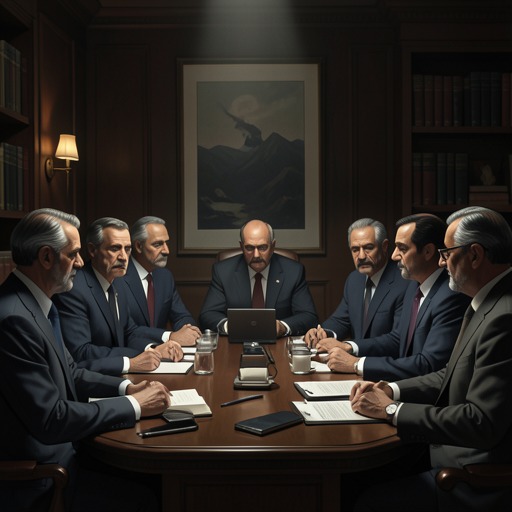
The Allies’ list of 104, also called the Black List, exposes the gap between demand and enforcement. Its subjects are described as Germans who actively helped advance Hitler’s project and could not plausibly hide their responsibility behind obedience or military discipline. The list is meant to press Spain to act, but Foreign Minister Martín-Artajo lets time pass before meeting the Allied representatives. When he finally does, he produces documents, letters, and certificates the visitors have not previously seen, offering differing grounds for refusal: some men are said to have been Spanish citizens for years, some to have received nationality for wartime service, some to be missing or unknown, and others to be protected by economic or religious considerations.
Only one woman appears among the 104: Clarita Stauffer. The Allies give her correct Madrid address, at 14 Calle Galileo, and describe her as a principal organizer of a secret German aid association. Their account specifically links her to supplying false documents and finding work for Germans, and says she received special authorization from the German embassy to obtain Spanish nationality so she could continue such activity after defeat. Spain’s refusal to hand her over is presented not as an isolated irregularity but as part of a larger system in which citizenship and official standing can shield the networks that help fugitives survive.
Argentina’s invitation
The novel carries the new political calculation across the Atlantic. At a gathering convened by Rodolfo Freude, Perón publicly presents his “third position” as opposed to both Marxism and liberalism, communism and capitalism. The speech supplies an ideological frame familiar to the European guests, but the meeting’s practical purpose is more direct: Perón wants to receive civilian and military personnel connected to the Third Reich and use their technical and scientific expertise to make Argentina a power.
Perón’s calculation is explicitly shaped by Cold War expectations. He believes a future conflict between the West and the Soviet Union could turn those regarded as villains in the present into useful allies in the future, and he is prepared to welcome them. He asks Freude to convene the meeting, returns to the same group the following day to discuss further details, and personally proposes a confidential official body to handle the reception of such immigrants. The welcome is thus more than private sympathy: the president’s willingness to create an institution would give migration and concealment an administrative framework.
The people around the meeting show how this politics rests on connections as well as public doctrine. Freude’s father, Ludwig, a powerful German businessman in Argentina accused by the Allies of acting as Hitler’s unofficial ambassador, had faced extradition demands in 1945. Perón produced a false citizenship letter that allowed him to remain; Ludwig Freude later financed Perón’s election campaign. His son Rodolfo, Perón’s right-hand man, brings the Spanish journalist Víctor de la Serna to the gathering. De la Serna’s correspondence with Jean-Jules Lecomte uses talk of exporting a car as a thinly veiled way to discuss helping a fugitive cross the Atlantic. Political hospitality, money, personal obligation, and escape logistics converge around the same table.
What the shift does—and does not—resolve
The Cold War’s effects are visible in the contrast between formal accountability and practical impunity. Allied authorities can demand that fugitives be surrendered, assemble a list, and detain or prosecute some perpetrators. Hans Aumeier, for example, is arrested in Norway in June 1945 after the British intelligence service MI6 captures Gestapo files. Extradited to Poland, he is tried for his conduct at Auschwitz, denies the existence of gas chambers, and claims he is a scapegoat for Germany’s defeat. He is sentenced to death and hanged in Kraków on 28 January 1948. His crimes at Auschwitz, however, prevent his prosecution for the Klooga massacre. The case preserves the reality of legal action while showing its limits: one set of crimes is tried, while another remains outside the judgment.
The novel’s treatment of the Cold War makes the reversal both geopolitical and personal. Sal Burnstein’s determination to remember his murdered family develops alongside the recruitment of former SS officers by Western powers. The Allies seek names and extraditions while their own officials increasingly prioritize anti-Soviet intelligence. Franco’s government exploits that contradiction, and Perón offers a destination where Reich-linked expertise may serve a new national project. In this structure, the postwar question is not only whether the perpetrators are guilty, but whether guilt still matters to governments that have begun to value them for other purposes.
A politics of changing identities
The Cold War gives identity and documentation a particular force across the novel. A fugitive can be hidden by a false name, but a regime can do more: it can grant nationality, issue authentic papers, and make the assumed identity usable in business and public life. The Black List names this machinery from the Allied side, while the Spanish defenses and Argentina’s proposed reception apparatus show its political uses. Official documents do not settle the question of responsibility; they can instead make responsibility harder to pursue.
That tension also frames the book’s use of historical materials. Lists, captured files, correspondence, and personal records do not speak with equal authority or arrive at the same moment. The empty German embassy in Madrid, stripped of its records and valuables before Allied representatives enter in June 1945, dramatizes how much can disappear before official inspection begins. Against such absences, the named 104, the address assigned to Stauffer, and the prison records concerning Aumeier become evidence of what could be documented—and of how documentation could still be obstructed or outpaced by politics. The Cold War is the larger pressure behind that instability: it does not merely follow the war chronologically, but reorganizes the meaning and usefulness of its surviving evidence.